
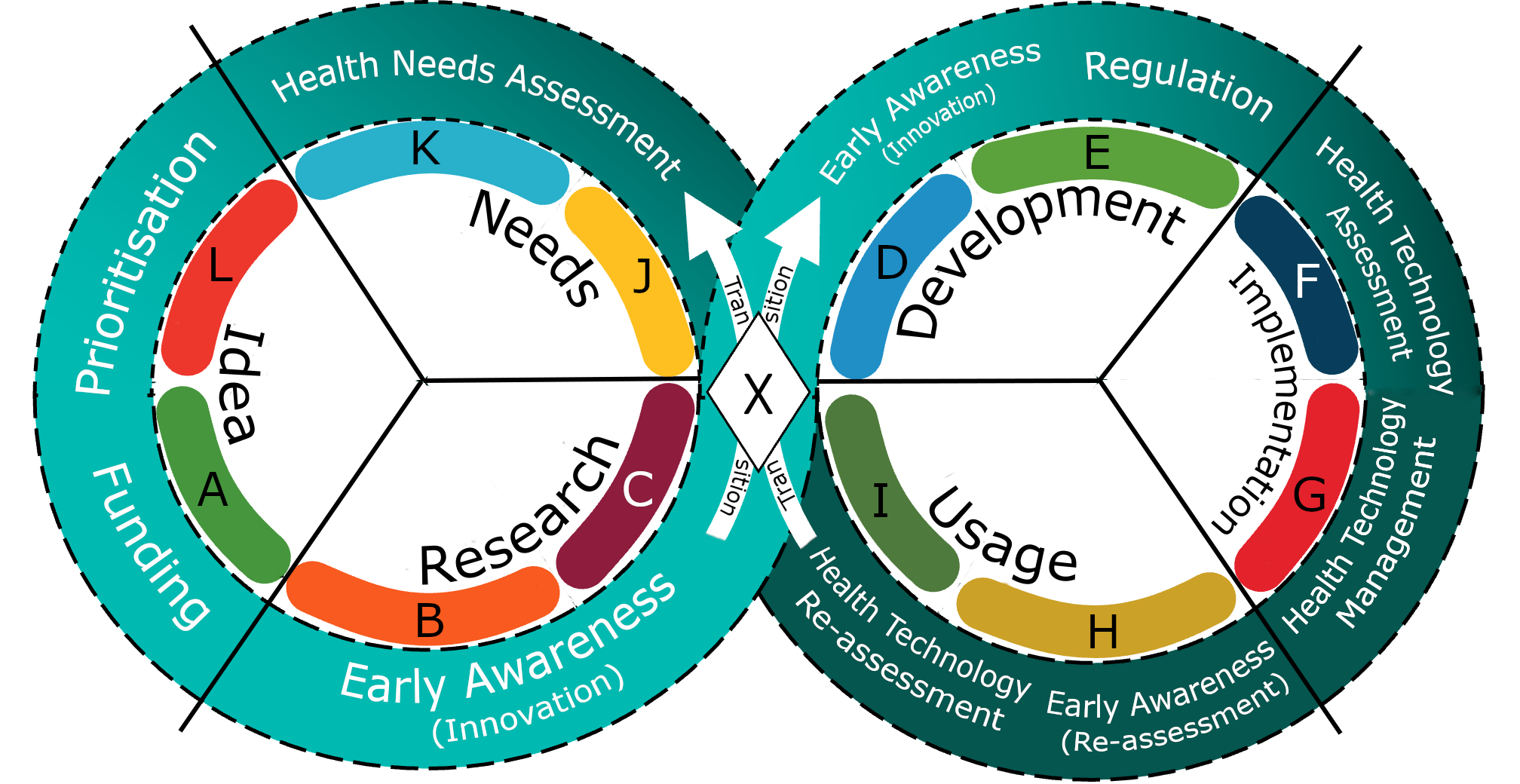
Every course is mapped to a phase of the life cycle of health technologies 2.0.
Health technologies move through six interconnected phases: Needs, idea, research, development, implementation and usage linked by a continuous knowledge-generation loop.
1. Needs — Identify health needs as gaps, burdens or risks experienced and translate priorities into collective action through policies, funding programmes, research calls, service specifications or procurement (system demands).
2. Idea — Identify and describe emerging technologies and potential solutions in response to system demand or technology-led opportunities.
3. Research — Generate early evidence on feasibility, safety, mechanisms of action and potential value.
4. Development — Build and validate the technology, applying phase-appropriate evidence standards on the path to regulatory readiness.
5. Implementation — Support reimbursement, organisational and individual adoption decisions, and prepare health services for use.
6. Usage — Generate real-world evidence, reassess technologies against anticipated benefit and use structured pathways to advance, adapt, redirect or discontinue practice—while feeding learning back into the identification and prioritisation of health needs and new system demands.
Choose your learning level. Progress with purpose based on a globally endorsed training framework.
Three levels of structured learning for the life cycle of health technologies 2.0.
Delivered where and how your organisation works.
Online SCORM courses
Self-paced modules deployable in any SCORM-compliant learning-management system.
In-person workshops
Facilitated on-site training for agencies, HTA bodies and industry teams.
Certification
Level-based certificates aligned with the EuroScan/i-HTS endorsed curriculum structure.
Institutional licences
Site-wide access for organisations.
Ready to bring life-cycle based training into your organisation?
Whether you need individual certification, a cohort licence or an on-site workshop — tell us where in the life cycle your team needs support most.
 Google